TEHDAS2 – die Joint Action von Mitgliedstaaten und EU-Kommission zur Vorbereitung der Einzelheiten der EHDS-Umsetzung – hat mit der Veröffentlichung einer Reihe neuer Leitlinien und technischer Spezifikationen einen weiteren Meilenstein erreicht. Diese Ergebnisse spiegeln die umfassende Zusammenarbeit zwischen den Mitgliedstaaten und der EU-Kommission wider und bauen auf den Rückmeldungen aus den öffentlichen Konsultationen auf.
Gleichzeitig läuft noch die dritte und letzte öffentliche Konsultation. Noch eingehende Rückmeldungen werden die noch ausstehenden Durchführungs-Verordnungen (Implementing Regulations) im Sinne der einheitlichen Gestaltung des Europäischen Gesundheitsdatenraums (EHDS) unterstützen.
Die TEHDAS2-Abschlusskonferenz ist dann für November 2026 geplant.
(die folgenden HInweise wurden von der TEHDAS-Website übernommen)
| D4.1 Guideline for health data access bodies on fees and penalties for non-compliance related to the EHDS regulation Read the guideline |
| TEHDAS2 has published guidance to help health data access bodies (HDABs) organise data access fees and oversee compliance under the European Health Data Space (EHDS).The document provides a practical reference for Member States preparing for national implementation and early operational activities. |
| D5.2 Guideline for health data access bodies on minimum categories and limitations on the reuse of health data Read the guideline |
| TEHDAS2 has published a new guideline to help health data access bodies (HDABs) assess whether a request for data is allowed, prohibited or subject to limitations under the European Health Data Space (EHDS). |
| D6.1 Guideline for health data holders on making personal and non-personal electronic health data available for reuse Read the guideline |
| TEHDAS2 has released a guideline for health data holders on making electronic health data available for secondary use under the European Health Data Space (EHDS). The document focuses on what happens after a national health data access body issues a data permit or approves a request. It places the role of health data holders (e.g. healthcare providers, registries, insurers and developers of health-related services and devices) within the wider EHDS framework and explains the main obligations and practical considerations for timely, consistent delivery. |
| D6.3 Guideline for health data access bodies on the procedures and formats for data access Read the guideline |
| A new TEHDAS2 guideline supports health data access bodies (HDABs) in processing data access applications and requests for the secondary use of electronic health data under the European Health Data Space (EHDS). The document outlines how HDABs can process both requests for anonymised statistical data and applications for access to individual-level data through secure processing environments (SPEs), covering the full lifecycle from receipt and pre-screening to decision-making and follow-up. |
| D6.4 Data Access Application Management System (DAAMS) – Technical specification for health data access bodies Read the specification |
| A new TEHDAS2 expert specification gives Member States a practical framework for building systems to handle health data access applications and requests under the European Health Data Space (EHDS). The document sets out how to develop a Data Access Application Management System (DAAMS), a national platform designed to support secure and compliant access to electronic health data for secondary use. It is intended to help health data access bodies (HDABs) manage applications and requests for purposes such as research, innovation and policymaking. It defines the technical and functional requirements for DAAMS and covers the full lifecycle of applications, from submission and evaluation to decision-making. Core features include application tracking, structured assessment and permit handling. |
| D7.2 Guideline for health data access bodies on data minimisation, pseudonymisation, anonymisation and synthetic data Read the guideline |
| A new TEHDAS2 guideline explains how health data can be safely accessed and used under the European Health Data Space (EHDS). It provides practical guidance on data minimisation and privacy-preserving methods throughout the data access process for those involved in the secondary use of sensitive health data. Intended for health data access bodies (HDABs), data holders and data users, the document explains at what level of detail and under which safeguards data can be accessed under the EHDS. It supports decision-making across the full user journey, from data access applications to analysis and the export of results. At the same time, it enables research, innovation and policymaking while helping to ensure that access decisions remain proportionate, and privacy risks are controlled. |
| D7.3 Technical specification for health data access bodies on the implementation of the common IT infrastructure Read the specification |
| TEHDAS2 has published a technical specification explaining how Member States can connect to HealthData@EU, the EU infrastructure for secondary use of health data under the European Health Data Space (EHDS). The document is intended for health data access bodies (HDABs) and national authorities preparing for EHDS implementation. It focuses on the common technical components and interfaces used to link national systems with HealthData@EU, enabling structured and interoperable information exchange between countries. Connecting to HealthData@EU in practice: The HealthData@EU infrastructure serves as the digital backbone connecting National Contact Points with the HealthData@EU Central Platform. This distributed architecture ensures a balanced governance model: the European Commission operates the central core, while Member States implement and maintain their national components. The specification describes how national components interact with the HealthData@EU Central Platform operated by the European Commission, outlining the main technical elements, operational roles and division of responsibilities between Member States and the EU. |
| D7.4 Technical specification for health data access bodies on the implementation of secure processing environments Read the specification |
| TEHDAS2 has published technical specifications defining how secure processing environments (SPEs) required under the European Health Data Space (EHDS) should be designed, operated and governed. The document provides health data access bodies (HDABs) with a common basis for implementing SPEs for the secondary use of electronic health data. The document outlines the minimum technical, functional and security capabilities that SPEs must offer. Under the EHDS, HDABs must grant access to data exclusively through controlled environments that enforce strict safeguards for confidentiality and security. These SPEs may be offered as a service from outside the HDAB organisation. A high-level framework for implementation: The specification sets out minimum requirements for SPEs and the capabilities needed to protect sensitive data while enabling scientific research. It provides a common reference for implementation across national settings. It also defines baseline interoperability requirements for SPE-based federations, supporting data processing across organisations and Member States. The document is intended to inform follow-on technical guidance, standardisation work and the European Commission’s implementing acts. In doing so, it emphasises the value of a consistent approach to SPEs across Member States as a basis for trust. |
| D8.1 Guideline for health data access bodies on implementing opt-out from the secondary use of health data Read the guideline |
| TEHDAS2 has published a guideline to support health data access bodies in implementing the European Health Data Space (EHDS) opt-out right for secondary use of electronic health data. The guideline outlines key requirements for managing opt-out choices and where Member States have flexibility in organising technical and operational arrangements. The document provides practical guidance on how individuals should be informed about the opt-out, how their choices can be recorded and managed, and how those choices should be respected when health data is made available for purposes such as research, innovation and policymaking. It also outlines the respective roles of health data access bodies, data holders and supervisory authorities in supporting implementation. |
| D8.2 Guideline for health data access bodies on implementing the obligation of notifying the natural person on a significant finding from the secondary use of health data Read the guideline |
| TEHDAS2 has published a guideline for health data access bodies on handling significant findings arising from the secondary use of electronic health data under the European Health Data Space (EHDS). It sets out how such findings should be managed securely, transparently and in line with national rules. The guideline makes clear that health data access bodies are not responsible for clinical validation or for contacting individuals directly. Their role is to receive notifications from authorised data users and securely forward the information to the relevant health data holder, while clinical assessment and decisions on whether and how to inform a person remain within national frameworks. |
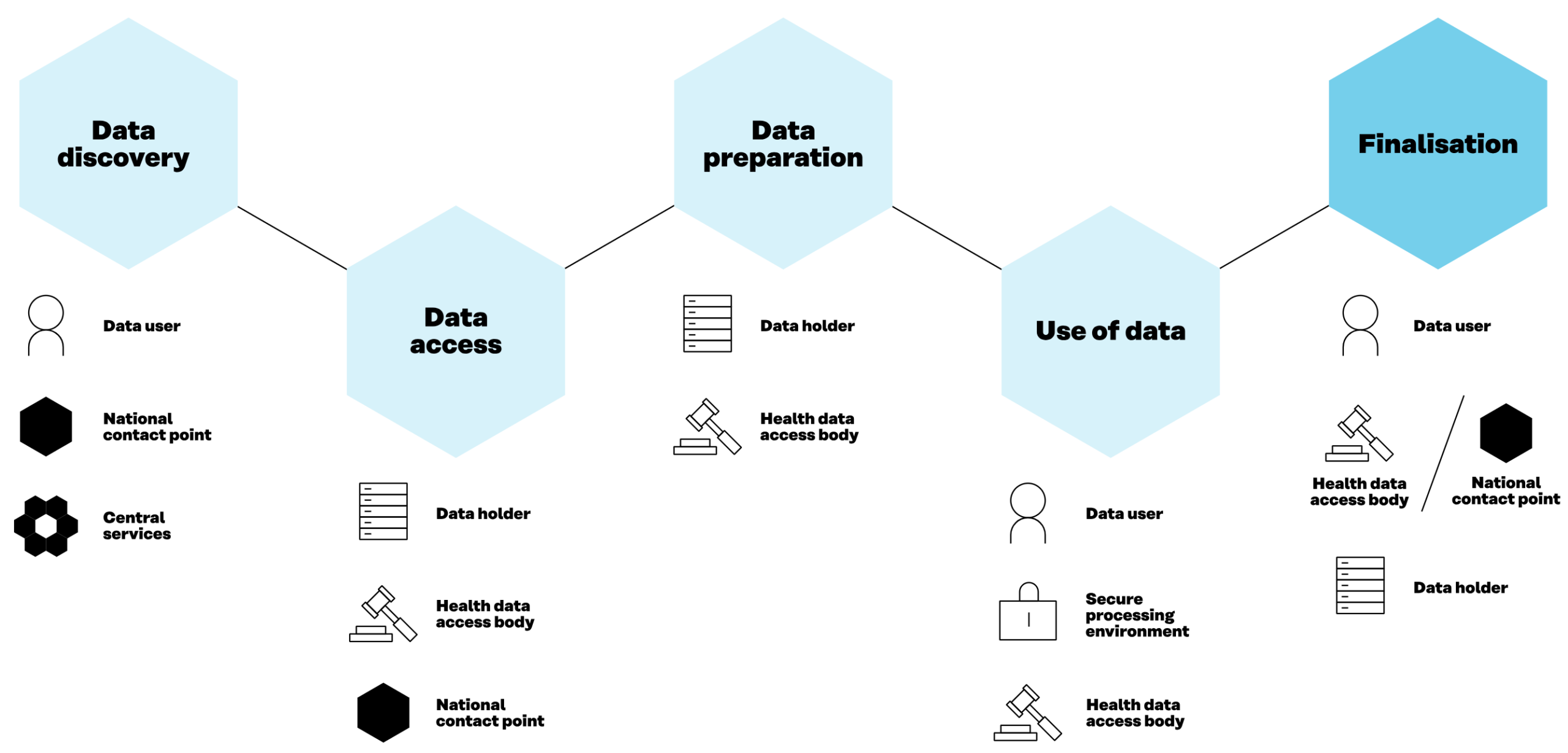
| These and previously published guidelines can be explored on the Results page of tehdas.eu in two complementary ways: by user group or by phase of the EHDS user journey. |
- TMF-Webinarreihe zur 3. Runde der TEHDAS Konsultationen
- Verordnung (EU) 2025/327 des Europäischen Parlaments und des Rates vom 11. Februar 2025 über den europäischen Gesundheitsdatenraum sowie zur Änderung der Richtlinie 2011/24/EU und der Verordnung (EU) 2024/2847
- Fact Sheet Europäischer Gesundheitsdatenraum (update 03/2024)
- Gesundheitspolitik der EU (Hintergrundinformationen)